Tuesday, October 8, 2019

City Life (cont'd)


    Hard to predict what brings about spontaneous conversations between strangers on a city street. Most likely, I'd wager, they occur after inadvertent physical contact, say between bicycle (or scooter) and pedestrian. Such are the joys of a busy pathway, scene of a recent close encounter when the two headed in the same direction, scurrying along unawares. The young woman perched on an extra wide handle two-wheeler whizzed past within inches. "Whoa,"  was all I could think to say. Which brought her to a stop and a look of annoyance on her face . "Would you consider maybe putting a bell on your bike, or some device to help warn people?" That wasn't what she expected  - someone slowing her right to  ride. "You could hurt someone and then have a nasty lawsuit on your hands." I hurried to say I wasn't criticizing her choice of the sidewalk - it's free for everyone after all.
"That's what the children I care for have on their bike," she said, thoughtfully, agreeing - a compromise on her part, I could tell. My suggestion at least made her pause and consider the idea and left me pleased (deceived?) thinking that at least civility had won the day. I walked on imagining she might actually purchase a whistle, horn or bell. She rode away, happily free.
-----------------------------------------------------

 Sometimes it only takes a quick look at a bulletin board to be content that citizens are indeed monitoring public spaces. Above in small type, carefully printed out warning to random folks coming to a car wash to observe some underserved common courtesies. Protect the public realm, the note implores. Let others enjoy the intimate silence of their own smartphone conversations without having to listen to strangers blabbing aloud rudely in the waiting room. Off to the side was another printout, of names of those who fled the scene without paying a dime - the damned forever unwelcome. And the humorous notice posted above the entry way, before customers give up their keys, about what could be  carelessly lost and forgotten in their vehicles so that they dare not charge the employee with pilfering....

-------------------------------------------------------

Saturday, September 28, 2019

Hirshhorn Plaza Pleasures in Autumn


Without a doubt, 'Open Dimension' best describes the spirit - and latest exhibit - of the Smithsonian's Hirshhorn Museum.


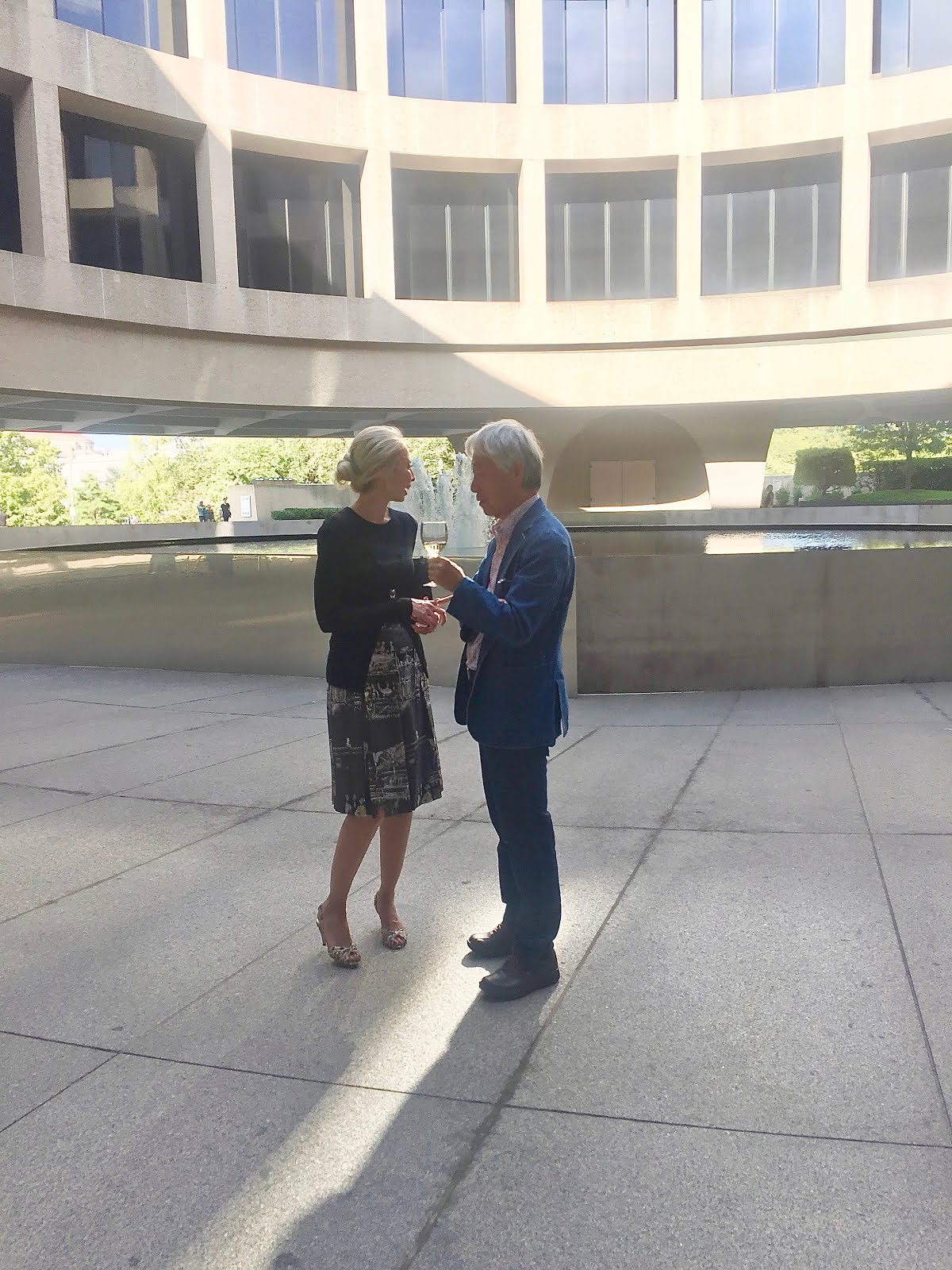
Unusual among the many attractions on the Mall, this rotund building, which opens out into a sculpture garden,  is offering free public programs and sketching sessions on two more early October evenings in and around the 4.3 acre open air plaza. Drinks and tasty bites are also available. Such enticements are in line with the installation of ten stone and steel sculptures by Korean-born artist Lee Ufan.  Hirshhorn director Melissa Chiu is shown above talking  with Lee Ufan  in front of his Box Garden, a labyrinthine fountain piece directly under the sky.
The tension between seemingly unrelated materials is deliberate, as was the choice of each individual stone - heavy granite shapes weighing hundreds of pounds. Each boulder was chosen to be part of what he terms a dialogue that is up to the viewer to construct for him or herself.  The simplicity of the designs, which fall under a single title "Relatum," is disarming and is intended to provoke. What could be more  different than the contrast between natural stone and manmade industrial steel, up against the slippery elusive flow of water? A media release states that the show, to continue into September 2020, is the artist's largest 'site-specific outdoor sculpture project in the U.S., the first exhibit of his work in Washington, and the first time in the museum's 45--year history that an artist has been invited to take over the entire plaza space.

Sunday, September 22, 2019

Tree Talk at the US Botanic Garden

 Here is a very happy man, an arborist exclaiming with his arms telling us urbanites in the U.S.Capitol's Botanic Garden why trees may be more adaptable in the world than people. Why  trees often have amore choices in how to live than most human beings. Not surprisingly, he is author of several books on the subject of trees ("Sprout Lands" is the latest), promoting the  idea of how man and these big plants can best get along.
Quoting from the preview outlining his tour, cleverly titled "Tree Jazz" (for good reason), his message gives one hope.

Human beings have 78 organs; trees have only 3—root, stem and leaf—but trees live longer and are far more resilient than are human beings. Much like a jazz player, a tree lives by first stating its ancestral pattern, and then by repeating that pattern in every way possible for the rest of its long life. The branches that form on the tree as it grows are literally reiterations of the original form, and in fact, most of them begin life with their own root systems, which are linked to that of their parent tree. In the meantime, whenever damage, insects, diseases, bad weather, pruners or other misfortunes strike the tree, it responds with new repetitions of itself, creative reiterations, like a jazz player’s improvisations on a theme. In this way, out of only three organs and 24 patterns, trees are able to grow an infinity of unique forms. 


Sunday, September 15, 2019

Big Town or Little City (contd)

  I took a photo of this defrocked mail truck when I saw a stranger doing the same thing.  Observing offhand as I was, thinking the vehicle a remarkable sight on an unremarkable street on Billings, Mt., north (i.e. less impressive, older) side. What's striking is the rainbow decor, of course, a statement of defiance perhaps.  It wasn't a coincidence that the empty truck was parked next to the grassy arena where a community celebration of gay pride and people was taking place. And what a scene there: all ages and costumes. Clever how the repurposed truck's rainbow colors parallel the staid red and white stripe of the estimable U.S. Postal Service. What would happen, I'm wondering, if any of the mail delivery men or women wore those same  multicolored ribbons on the job? How fully regulated are they? Imagine a rainbow printed bikini on really hot day  with the mail carrier's bag slung over his/her shoulder...
 Recent graffiti targeting gays on downtown streets brought out more people than usual to this Sunday afternoon parade and festival happening in the state's largest city (or its biggest small town).   Think what you might: times are a'changin in ways great and small, even in Trump country.

Monday, August 19, 2019

Noted In Passing on 8/19/19 and 8/31/19

What is a cosmopolite? A cosmopolitan person? Someone who looks outward perhaps (i.e. the cosmos...) in every sense of the word?

A word to play with, especially for those of us who tend to associate the adjective with an urban mentality. A city person is bound to look out and around just by virtue of being surrounded by other human beings on a regular basis. As in shoulder to shoulder in the public arena.

Anyone curious about how far to carry such matters should look to a new book by philosopher/professor Martha Nussbaum (University of Chicago) titled "The Cosmopolitan Tradition: A Noble But Flawed Ideal" who plays with the question "Is There Such a Thing as the Ethics of Cosmopolitanism?" (Harvard University Press). Count on some historic references and inferences. An excerpt can be found in today's BookMarks web, as noted in Lit Hub Daily today....

-----------------

The day a report was issued by a somewhat obscure agency (the Economist Intelligence Unit) naming Washington DC as 'one of the safest large cities of the world, ' the local paper (Washington Post) wrote of a 'rash of violence' in and around the District. Of course, such things are relative, but maybe the 110 people slain to date this year don't exactly tally as a crime wave. The city was the only U.S. city in the top 10 cited, and only one of two in North America along with Toronto.
The Economist's index publishes biannually, ranking 60 cities across six continents. Tokyo, Singapore and Amsterdam were rated higher on this somewhat obscene scale.
Hong Kong - no surprise these days - dropped from 9th to 20th. The District had risen from 23rd two years ago.
It all depends on how the data is compiled. Violent crime in the District 'has been steadily declining' while homicides have gone up 13 percent since last year. What helped bring DC up  in the ratings was said to be the city's concentration on "intense disaster preparedness.'
Relative, you have to say. One person being killed and six wounded in a 24-hour period doesn't amount to a hill of beans. It's just a 'rash.'

Thursday, August 8, 2019

Notes From Afar: An Editorial


           From the Economist magazine, August 3/19: This curiously named 'Charlemagne' column datelined Europe that plugs the rise of the electric scooter fad as perhaps less folly than welcome phenomenon. The anonymous writer reflects on how the trend might herald the eventual demise of the car in urban milieus - hence, an end to traffic jams,  pollution, all manner of inconveniences now menacing those of us who relish inner city living.
           Well, nice if you can get it as the saying goes.  Obviously, many cities have risen to the challenge by construction of bike lanes, increased parking and operating charges, encouragement of commuter routes and services. The writer sees a 'gradual retreat of the car from the European city,' indeed, across the entire continent. How far such moves extend on the American continent has yet to be tested, because local governments are what determine  the urban profile and so consistency is rare.
New York is doing an exceptional job up against formidable challenges. A full page in the Friday Aug. 9 New York Times print edition is headlined "Cars No Longer Welcome on Busiest Stretch of Manhattan's 14th Street."  The inspiration apparently came from our northern neighbor Canada's Toronto, which tackled its busiest thoroughfare with restrictions - i.e. blocking cars on a 1.6 mile street. Streetcars could then speed up and do the job they were intended for.  The average speed of buses on New York's 14th Street has been 4.5 mph, 'among the slowest of any American city,' according to The Times.
       There is only so much one can do to choose Metro service in the greater Washington, D.C. area when the three area jurisdictions in charge seem always to be feuding over who owes how much and why to make the system operate. Let your representative - whoever answers to the name - know how you feel about such matters. Put feeling into your message. 

Tuesday, August 6, 2019

Update: The City in Summer

Some advantages to note:
Metro - Washington's subway - is less crowded. Tourists often are the crowd, especially Europeans whose August traditionally is their travel time. Locals can feel superior when they see strangers puzzling over iPhones, looking for directions that are not always clear. One very buttoned up man with briefcase took time from his stride to counsel such a group alighting recently at Pentagon City mall and looking stranded on the platform. He stopped voluntarily when he saw their dilemma and asked to help.
The huge glass Mall hub above them hummed with activity - an obvious place to hide from hot air and sun.
Festivals are everywhere, and free entertainment of a high and low sort flourishes. Author readings continue nonstop at bookstores are  since most authors these days must rely on personal appearances to spread the word. They offer the best antidote to warmed over TV shows, often still in repeat mode until September. Among the best of these lately was Ocean Vuong, a slender young man, sitting in conversation with poet Jenny Chang at Solid State on H St. NE. It was the last of these on his current schedule another standing room only audience drawn to his novel and its remarkable title: On Earth We're Briefly Gorgeous.  He was 'gorgeous' in manner and mind.
 First, by praising the audience before he had even said a word about his book, pointing out their attendance as solid value to the community, of which the store is a vital part. That produced a round of clapping from his admirers who, not surprisingly,  included a great variety of so-called minority faces. They rushed to hug him at the end, grateful to be acknowledged and impressed by his theme: survivorship may mean hardship but is at the same time "an incredibly creative act." Immigrants such as himself  - the son of an illiterate Vietnamese mother - often grow up in harrowing circumstances and still learn to fashion themselves in original ways. For him, language was the tool; his early  public school teachers  showing him how to use it.